
Green Pool Water – A Practical 5-Day Recovery Guide - Karma Pro Pools
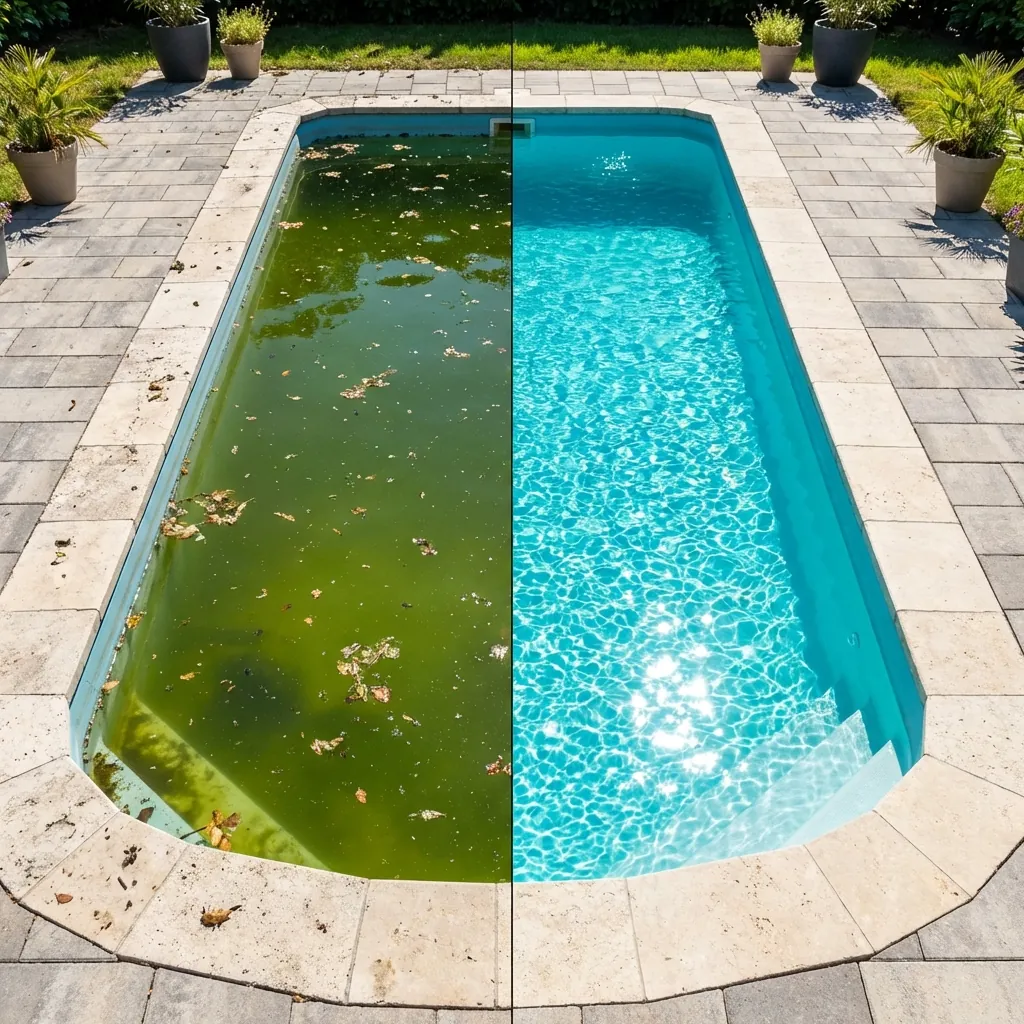
Green pool water can be caused by algae or metals. Find out how to identify the correct cause and follow our 5-day protocol to clear the water.
You wake up in the morning, look at the pool, and the water that was clear yesterday is emerald green today, or as murky as a swamp. It is a frustrating problem, but an extremely common one. Before you throw in chemicals at random (or buy "miracle tablets" off the shelf), stop. The wrong treatment ("I added chlorine and it turned even greener") can cost you hundreds of RON and lost days.
This guide will not just tell you "add chlorine". It will give you a technical protocol applied in real pool recovery service call-outs, to take the water from "Green" to "Clean" in 5 days through professional algae treatment.
Why pool water turns green
The generic term "green water" can hide two completely different problems. There are two main enemies that cause this effect: Algae and Metals (Iron/Copper). Their treatments are OPPOSITE. If you confuse them, you will make the problem worse.
Algae vs. Metals (The Critical Difference)
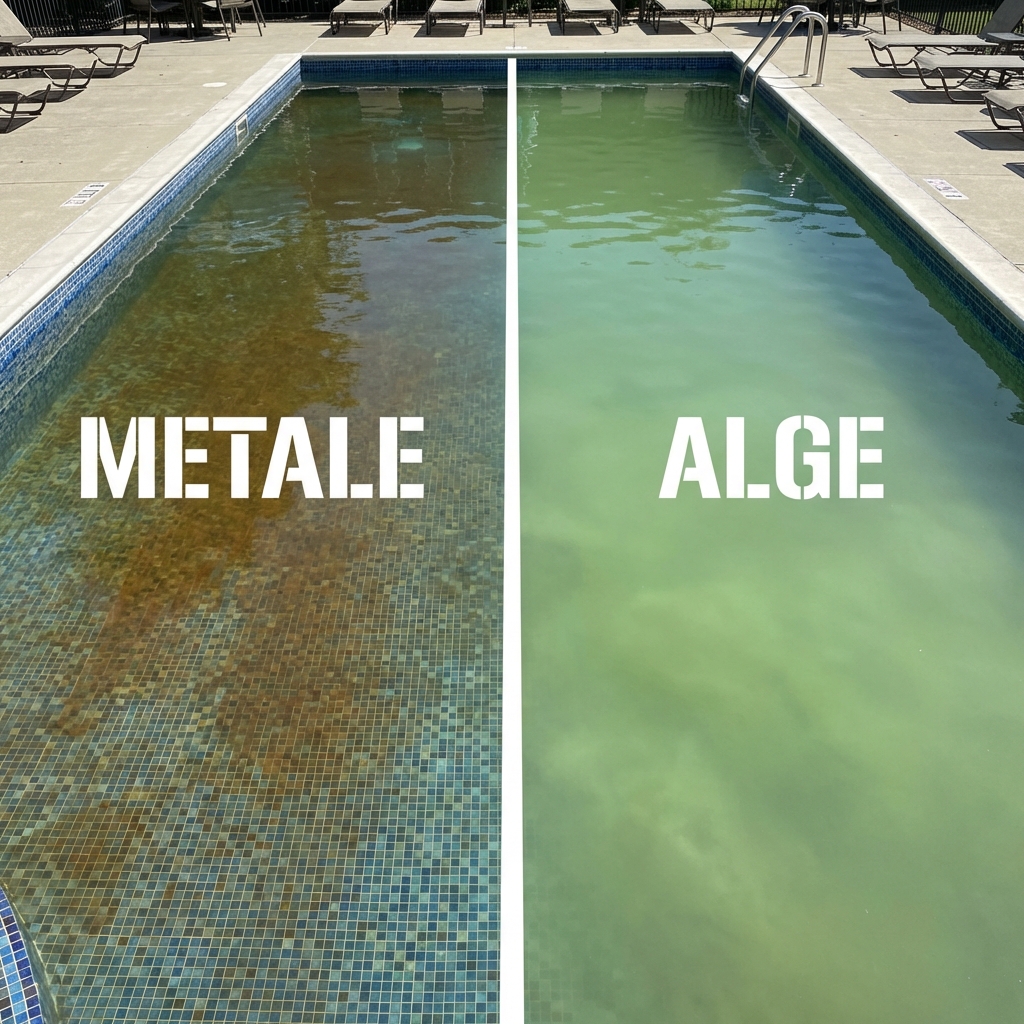
How do you know whether you have a biological problem (Algae) or a chemical reaction (Metals)?
| Characteristic | ALGAE (Biological) | METALS (Chemical) |
|---|---|---|
| Appearance of the water | Cloudy, milky, opaque green. You cannot see the floor. | CLEAR green (Emerald). The water is transparent, but coloured. |
| Speed of onset | Gradual (1-2 days), after rain or neglect. | Instant (minutes/hours) after adding chlorine (Shock). |
| Pool walls | Slippery, with a slimy layer. | Rough or normal (not slippery). |
| Treatment | Shock Chlorine + Algaecide. | NO CHLORINE! A Sequestrant is used. |
TIP: Do the practical test: Put your hand in the water and rub the pool wall. If it is slippery like soap = ALGAE. If it feels rough (normal) = Possibly METALS.
The Bucket Test (for confirmation):
- Take a bucket of water from the pool.
- Add a spoonful of dissolved chlorine.
- If the water clears (loses its green colour) = ALGAE.
- If the water darkens (turns brown/deep green) = METALS (The chlorine has oxidised the iron).
WARNING! The Vitamin C Myth: Although Vitamin C clears metal-tinted water instantly, it is a false solution. It consumes all the chlorine in the pool and the metals return within 2-3 days. See the full technical analysis: Vitamin C in the Pool - Solution or Mistake?
*Note: The protocol below ("Green-to-Clean") is dedicated to ALGAE contamination. For metals, stop the chlorine and use a special Metal Sequestrant.*
"I added chlorine to the water, but it is still green!" (Why isn't it working?)
You added shock chlorine last night, and today the water looks the same. Why? Pool chemistry does not work "by ear". Chlorine is a soldier that can be disarmed very easily by two factors:
- Alkaline pH (> 7.6): If the water pH is 8.0, your chlorine is only 20% active. The other 80% floats inertly, killing nothing. Golden rule: Adjust the pH first, then chlorinate.
- Cyanuric Acid (The Stabiliser): If you use "Triplex" tablets or stabilised granular chlorine for a long time, you build up cyanuric acid (CYA). When CYA exceeds 50-70 ppm, it "locks up" the chlorine and no longer allows it to attack the algae.
- The extreme solution: If your CYA is above 100 ppm, the only solution is to partially drain the pool and replace it with fresh water. No chemical removes stabiliser from the water.
How we restore the pool to ideal condition in 5 days
Have you established that it is algae? This is the battle plan. Follow the order – chemistry needs time. If you do not have time to deal with it personally, you can always call on a rapid intervention.
Day 1: Adjusting the Parameters and Shock Treatment
Objective: Eliminating the algae and preparing the ground.
- Adjust the Alkalinity: A critical step that is often ignored. If the Alkalinity is not between 80 - 120 ppm, the pH will be unstable.
- Adjust the pH: Once you have adjusted the alkalinity, bring the pH firmly down to between 7.0 - 7.2. Chlorine is 10 times more effective at pH 7.2 than at pH 8.0.
- Intensive Brushing: Scrub the walls and floor of the pool with the brush. Algae hide in a protective biofilm; you need to dislodge them so the chlorine can attack them.
- The Chlorine Shock: Add fast-acting chlorine (granules or liquid).
- Dosage: Triple the normal dose. (E.g. If you normally add 100g, now add 300g).
- Important: Dissolve the granules in a bucket before pouring them into the pool!
- Filtration: Run the pump 24h continuously.
Day 2: Neutralisation
Objective: Preventing recurrence.
- Check: The water should be less green, perhaps turning grey/milky (a sign that the algae are dying).
- Brush again: Any trace left on the walls is a nucleus for re-infection.
- The Algaecide: Now, 12-24h after the shock, add the shock dose of Algaecide. The chlorine has killed the algae; the algaecide destroys its spores and membrane.
Day 3: Clearing (Flocculation vs. Clarifying)
Objective: Getting rid of the "haze" in the water (the dead algae).
Here you have to choose according to your filter. VERY IMPORTANT! Flocculant is used exclusively with sand or glass filters, not with cartridge filters.
- If you have a Sand / Glass Filter: You can use Liquid FLOCCULANT.
- Switch off the pump. Move the valve to RECIRCULATE.
- Pour the flocculant (diluted) over the entire surface of the water.
- Let the pump run on Recirculate for 30 min (to mix it), then SWITCH EVERYTHING OFF.
- Leave the water completely still overnight (Minimum 12 hours). The dirt will settle on the floor like a heavy carpet.
- If you have a Cartridge Filter (Intex/Bestway):
- ⚠️ DO NOT USE FLOCCULANT! (It will clog the cartridge instantly).
- Use a Clarifier (Coagulant). It works more slowly, but it is safe.
- Leave the filtration running and wash the cartridge 3-4 times a day.
Day 4: Removal
Objective: Getting the dirt out of the pool.
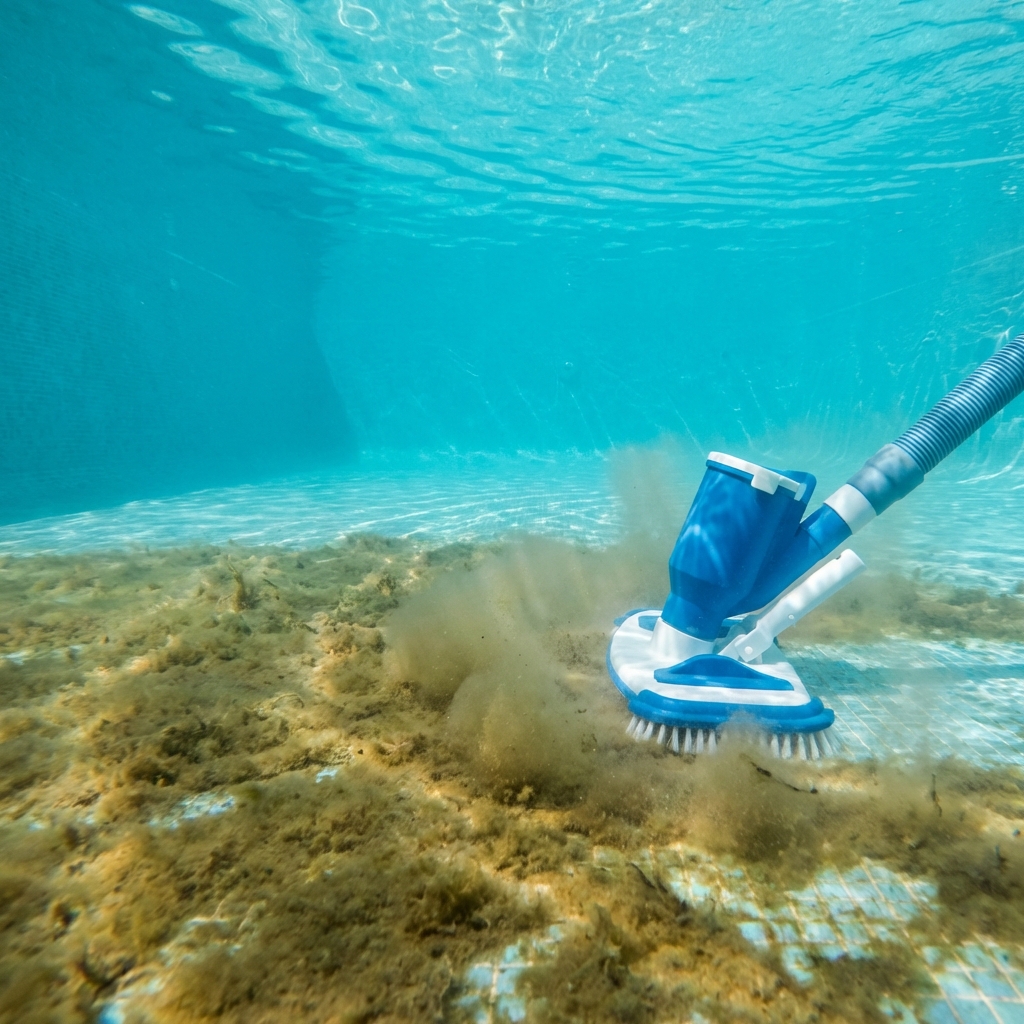
- (For those using Flocculant/Sand): In the morning you will find a layer of sediment on the floor.
- Set the valve to WASTE. NOT to Filter!
- Slowly vacuum the dirt directly to the drain. You will lose water from the pool; this is normal. Top up with the hose while you vacuum.
- (For those using Clarifier): Continue filtering and washing the cartridge until the water is crystal clear.
Day 5: Stabilisation
- Top the water up to level.
- Test the pH and Chlorine again.
- Add the maintenance tablets (Triplex).
💰 Estimated Treatment Cost: For a 30 m³ pool, the cost of the chemicals (shock chlorine, algaecide, pH minus, flocculant) is approximately 150-250 RON. If you call on a professional intervention, the total cost (chemicals + labour) ranges between 400-600 RON.
Why does green water come back even though we use chlorine?
You followed the plan, the water cleared, but a week later it is green again? You have a silent enemy in the water.
Phosphate Level: The invisible food
Phosphates are "protein bars" for algae. They enter the water from dust, leaves, rainwater or lawn fertilisers.
- The problem: You can have enough chlorine (2.0 ppm), but if phosphates are above 500 ppb (parts per billion), the algae have so much energy that they resist the chlorine.
- The solution: Buy a phosphate test once a season ("Anti-Phosphate test kit"). If you have phosphates, use a "Phos-Free" or "No-Phos" solution. By removing their food, the algae starve even at low chlorine levels.
Dead Zones (Circulation)
Standing water = Water that goes bad.
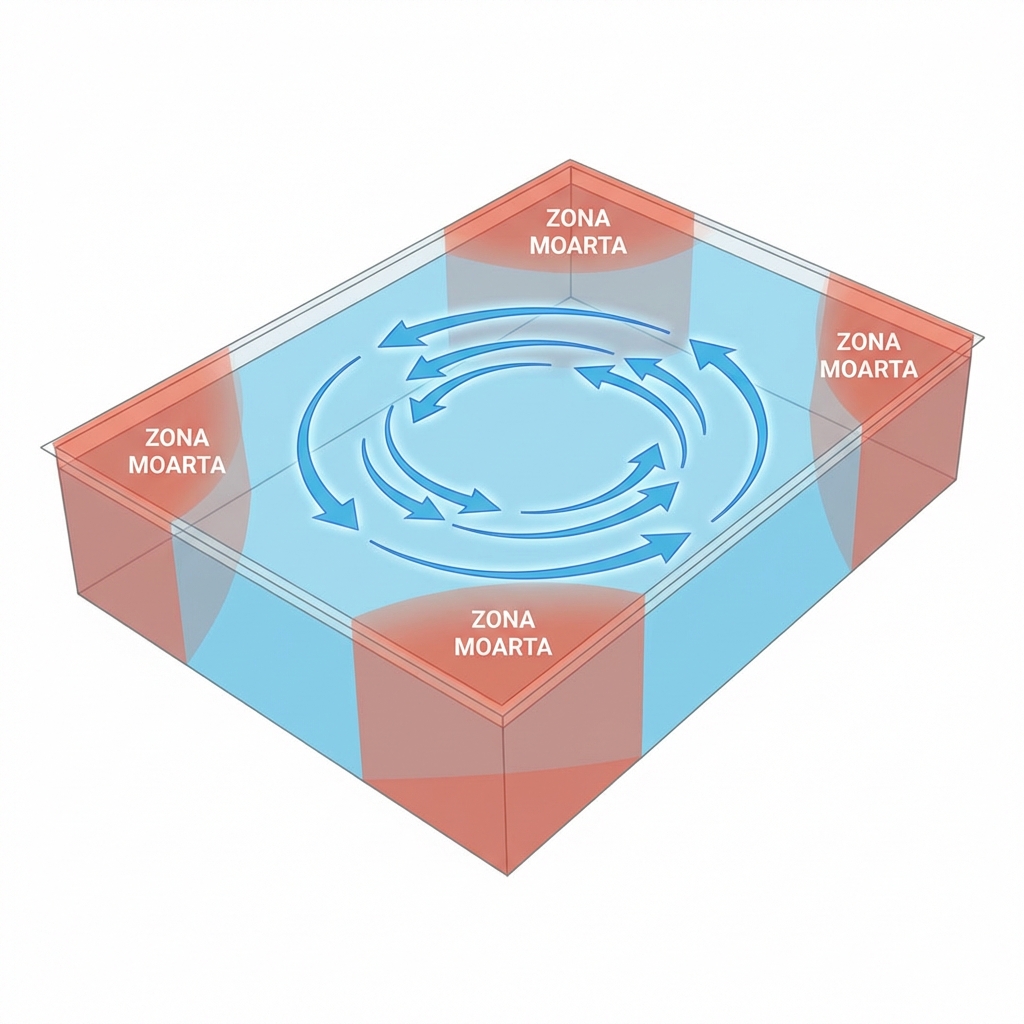
Algae appear first in the corners, on the steps or around the lights. Why? Because the water does not circulate there.
- Check: Point the return nozzles (jets) so that they create a circular swirl in the pool. The water should visibly rotate. If the nozzles only point up towards the surface, the pool floor remains a perfect "dead zone" for algae.
Which filter is most effective for green water
The battle against green water is won at the filter.
Sand / Glass Filters
They are the "tanks" of the industry. They withstand flocculant, are easy to clean by Backwash and can filter large volumes of dirty water. If you have a sand filter and still have frequent problems, check the sand. If it is older than 4-5 years, the grains have become rounded and no longer retain fine algae. Replace the sand with filter glass (which lasts 10 years). For full details on filter types and maintenance, see our guide to pool filters.
Cartridge Filters (Paper)
They are the weak point of above-ground pools. The cartridge has a small surface area and clogs within 2 hours of starting the algae treatment.
- The strategy: Buy 2 cartridges. Keep one in the filter and one being washed. Rotate them 3 times a day during the treatment. Without this effort, the water will never clear.
How we keep the water clean in the long term
Got rid of the algae? Congratulations! Now, keep it away.
- The Temperature Rule: How many hours a day should you filter? The formula: Water temperature / 2.
- Is the water at 28°C? Filter for 14 hours a day.
- Is the water at 30°C? Filter for 15 hours a day.
- Tip: Filter during the DAY, when it is sunny and warm, not at night.
- Measure Weekly:
- pH (7.0 - 7.4)
- Free Chlorine (1.0 - 3.0 ppm)
- Alkalinity (80 - 120 ppm)
- Cover / Tarpaulin: A covered pool does not photosynthesise. No light = No algae. Put the cover on when you are not using the pool.
🧪 Extra help: If you want to calculate the exact quantities of chemicals needed for your pool, use the Water Treatment Calculator.
FAQ – Frequently Asked Questions
Can I go in the pool if the water is slightly green?
It rained and the water turned green the next day. What should I do?
My tester shows high chlorine (5.0 ppm), but the water is still green. Why?
How long does it take to clear a green pool?
With cartridge filters or without flocculant, the process can take 4-7 days of continuous filtration.
Can I use well water for the pool?
How often should I shock chlorinate?
Can I replace chlorine with active oxygen or bromine?
Do I need to change all the water if it is very green?
Water still not clear? Book an intervention with our team!
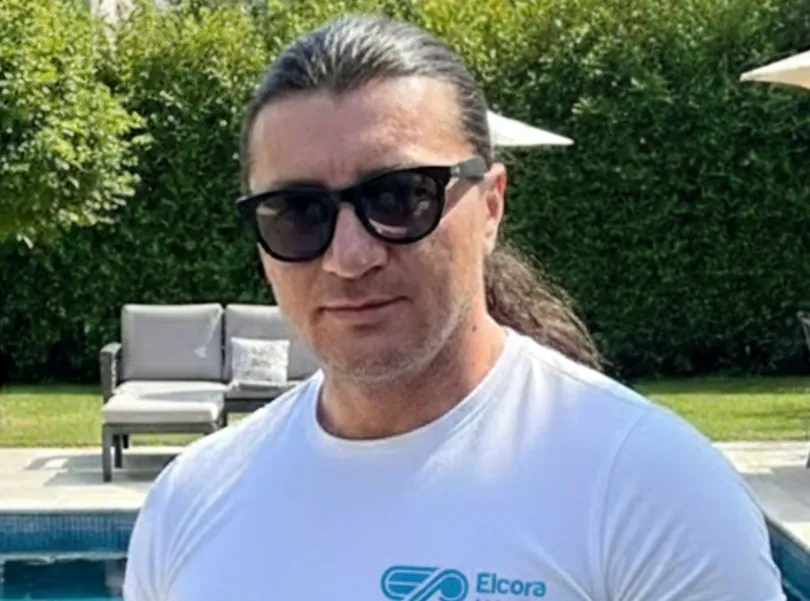
Eng. Răzvan Pavel
Technical Activity Coordinator at Karma Pro Pools as Technical Manager. Graduate of University Politehnica of Bucharest in 2000. Exclusively active in the swimming pool industry since 2007, coordinating over 500 residential and public projects.
Want a pool like the ones in magazines?
Book a free consultation with our experts and let's turn your dream into reality.