
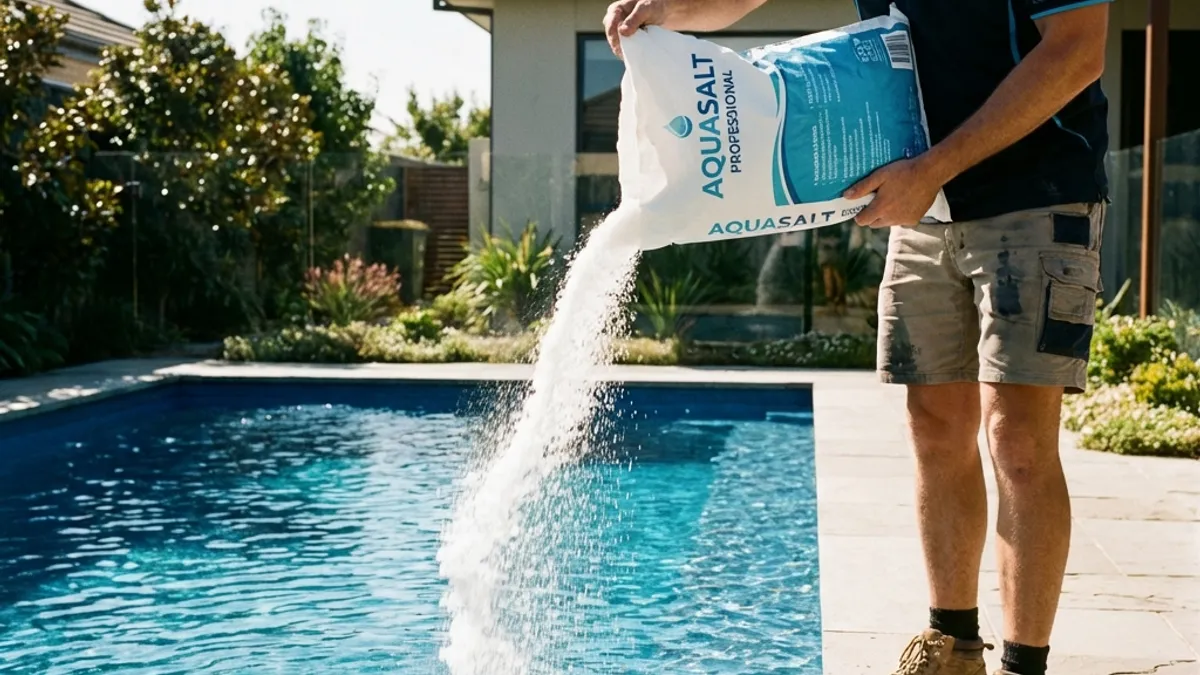
Treating Pool Water with Salt – How Electrolysis Works
Salt electrolysis is a disinfection method used in residential pools. Find out how the process works, how much salt is needed and how maintenance is carried out.
Salt electrolysis is a disinfection method used in residential pools. There is a common misconception: many people believe a salt pool "has no chlorine". In reality, salt is the raw material from which the system generates the chlorine needed for disinfection.
This article explains how the process works, how much salt is needed, what criteria the salt must meet and how maintenance is carried out.
How electrolysis works
The chemical process
If you dissolved salt in the pool and waited, the water would become salty, but it would not be disinfected. Plain salt (sodium chloride - NaCl) does not destroy bacteria, algae or viruses. To become an effective biocide, it has to undergo a chemical transformation through electrolysis.
The electrolyser is an electrical device that converts salt into active chlorine. Without this device, salt remains just a mineral dissolved in the water.
The difference between disinfection and filtration
Water treatment relies on two distinct processes:
- Chemical Treatment (Electrolysis): Kills microorganisms and oxidises invisible impurities (sweat, urea, bacteria).
- Physical Treatment (Filtration): Traps solid particles (dust, leaves, insects, dead skin).
If the pool filtration system is not working properly or the sand is clogged, the water will turn cloudy even if the electrolyser is producing chlorine. Water clarity depends roughly 80% on the quality of filtration.
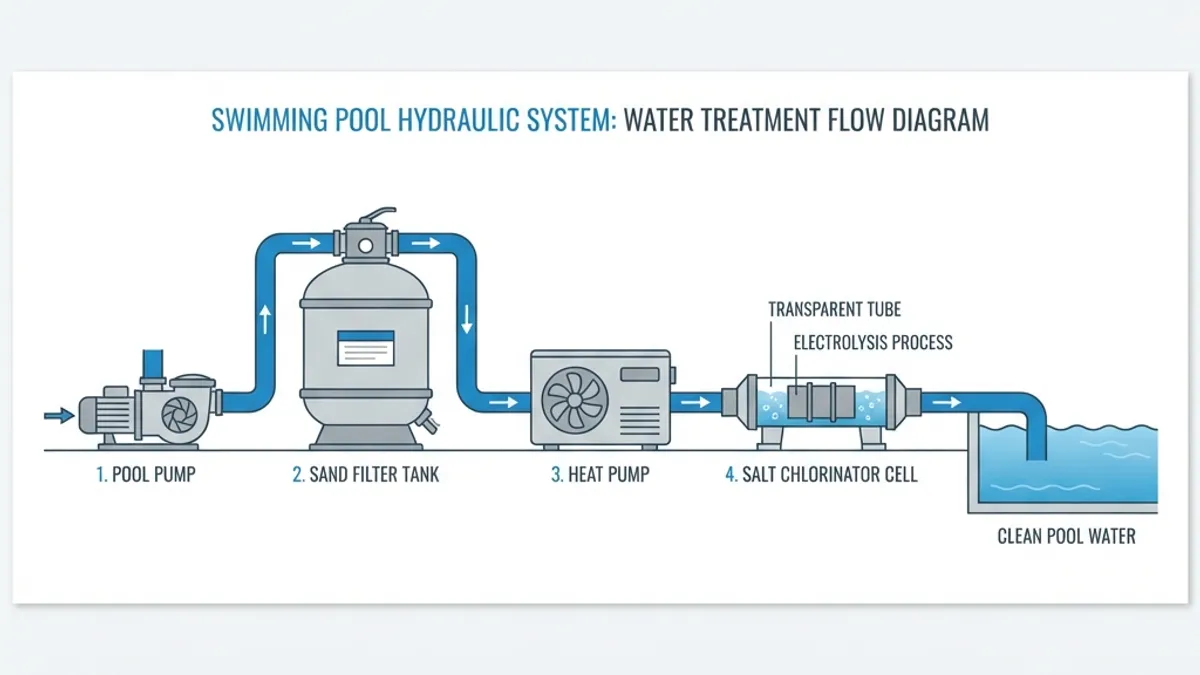
What happens inside the electrolysis cell
The electrolysis cell is installed on the pool's return pipe (after the filter and the heater). It contains parallel titanium plates coated with precious metals (such as ruthenium or iridium) that resist corrosion and conduct current.
When slightly salty water passes between these electrically charged plates, the electrolysis reaction takes place:
- The chloride ions (Cl-) from the salt are converted into chlorine gas (Cl2).
- The chlorine gas reacts instantly with the water, forming hypochlorous acid (HClO) – the same active substance as in liquid or granular chlorine.
- After the hypochlorous acid kills the bacteria, it recombines with sodium ions and turns back into salt (NaCl).
This is a closed cycle. Salt is not consumed by the disinfection process; it is regenerated.
The role of salt in chlorine production
Salt acts as a chlorine "reservoir". The amount of chlorine the device can generate depends directly on the conductivity of the water, which is determined by the salt concentration.
- Too little salt: Conductivity is low, chlorine production drops and the electrodes wear out prematurely.
- Concentration within the recommended range: The device operates according to its technical specifications (e.g. 20g chlorine/hour).
What electrolysis does and does not produce
Electrolysis produces pure chlorine, without stabilising additives (cyanuric acid), and provides continuous disinfection as long as the circulation pump is running.
Electrolysis does not regulate pH. On the contrary, the reaction also produces sodium hydroxide (caustic soda) as a by-product, which causes pH to rise over time. That is why a salt pool often needs pH Minus corrector to be added (automatically or manually). If pH is not controlled, problems such as green pool water can appear.
What type of salt is used
Characteristics of pool salt
Salt used in pools must meet certain criteria:
- Purity >99.5% NaCl: Any impurity (minerals, stone dust) will end up in the pool.
- No anti-caking agents: Table salt contains sodium ferrocyanide (E535) to keep it from hardening. This can stain the pool liner or tiles.
- Fast dissolution: Salt in tablet form or fine granules is recommended.
Why water softener salt is not suitable
Although salt for water softeners looks identical (also white tablets), it may contain additives specific to ion-exchange resins or impurities that can leave yellow/brown stains on the pool liner or on plastic steps. Bags specifically labelled "Pool Salt" are recommended.
Consequences of using unsuitable salt
Using unsuitable salt (coarse road salt, iodised table salt, etc.) can lead to:
- Permanent stains on the pool floor (caused by heavy metals such as iron or manganese present in unrefined salt).
- Cloudy water that will not clear.
- Cell failure: Mineral deposits on the titanium electrodes shorten their service life (which is limited anyway, usually between 5,000 and 10,000 hours).
How much salt to put in a pool
The salinity range
Each electrolyser manufacturer specifies an optimal salinity range, usually between 3000 ppm (3 g/l) and 5000 ppm (5 g/l).
- 3 g/l means 3 kg of salt for every cubic metre (1000 litres) of water.
- By comparison, seawater has a salinity of approx. 35 g/l. Pool water is therefore 10 times less salty.
Calculating the amount of salt
To find out how many bags of salt you need, you have to know the volume of the pool:
Pool Volume (m³) × Recommended Dosage (kg/m³) = Total Amount of Salt (kg)
Concrete examples for a standard pool with a typical dosage of 4 kg/m³:
| Pool Size | Average Depth | Water Volume (approx.) | Salt Required (Initial) | Number of Bags (25kg) |
|---|---|---|---|---|
| 6 x 3 m | 1.5 m | 27 m³ | 108 kg | ~5 bags |
| 8 x 4 m | 1.5 m | 48 m³ | 192 kg | ~8 bags |
| 10 x 5 m | 1.5 m | 75 m³ | 300 kg | 12 bags |
Check your equipment's user manual. Some "Low Salt" systems also work at 1.5 g/l, while others require 6 g/l. You can also use the treatment calculator for estimates.
When to top up the salt level
Because salt does not evaporate with the water, its concentration stays relatively constant. Top up with salt only when you physically lose water from the pool:
- After washing the filter (Backwash).
- When you partially drain the pool for winterising or repairs.
- After heavy rain that makes the water spill over through the overflow (fresh rainwater dilutes the salt water in the pool).
Example: If you wash the filter and discard 1 m³ of water, then top up with mains water, you have lost approx. 4 kg of salt.
What a salt water pool offers
Stable chlorine levels
Salt systems dose chlorine constantly, in small amounts, for as long as the pump is running. This avoids the large fluctuations typical of manual dosing (where you throw in chlorine, the level rises sharply, then drops towards zero until the next dose). The result is water that does not allow algae to develop, because there are no long periods without disinfectant.
How the water feels on the skin
Slightly saline water:
- Is less harsh on the eyes and mucous membranes.
- Dries the skin less after swimming.
- Reduces the "pungent" chlorine smell. The typical public pool smell comes from chloramines (chlorine combined with urea/ammonia). Salt systems oxidise these chloramines effectively, keeping the air around the pool more breathable.
Economic aspects
The initial investment (the equipment) is 500-2000 EUR, and the cell wears out and has to be replaced every 3-5 years (costing 30-50% of the device's value). In the long run, the costs are comparable to those of chlorine tablets.
Common myths about salt water pools
A salt water pool no longer uses chlorine
False. A salt pool is a home "chlorine factory". If you test the water with a tester, you will find free chlorine, exactly as in a conventional pool. The only difference is in how it is delivered.
The salt added to the water treats the pool
False. If your electrolyser breaks down, the salt in the water will not stop it from turning green. In this context, salt is chemically inert without electrical activation.
A salt water pool is a natural pool
No. A natural pool uses plants and biological filters. An electrolysis pool is a chemical system.
Any type of salt is suitable for electrolysis
Using other types of salt can lead to staining of the pool or equipment failure. Salt compliant with the EN 16401 standard (Salt for the treatment of swimming pool water) is recommended.
How maintenance is done
What to check regularly
- pH (Weekly): It naturally tends to rise towards 8.0-8.2. It must be kept between 7.2 and 7.6 using pH Minus (sulphuric/hydrochloric acid). A high pH blocks the action of chlorine, making it ineffective even if the device is producing at full capacity.
- Salt level (Monthly): Most devices have indicator lights ("Low Salt"), but it is a good idea to check with an independent tester as well.
- Stabiliser (Cyanuric acid): Electrolysis produces unstabilised chlorine, which is quickly destroyed by the sun's UV rays. You need to add stabiliser manually at the start of the season (20-30 ppm) to protect the chlorine produced.
Why filtration is still essential
Salt does not clear the water; it only disinfects it. Filtration must be serviced weekly (backwash) or whenever the pressure gauge shows increased pressure.
What to watch for in the electrolysis cell
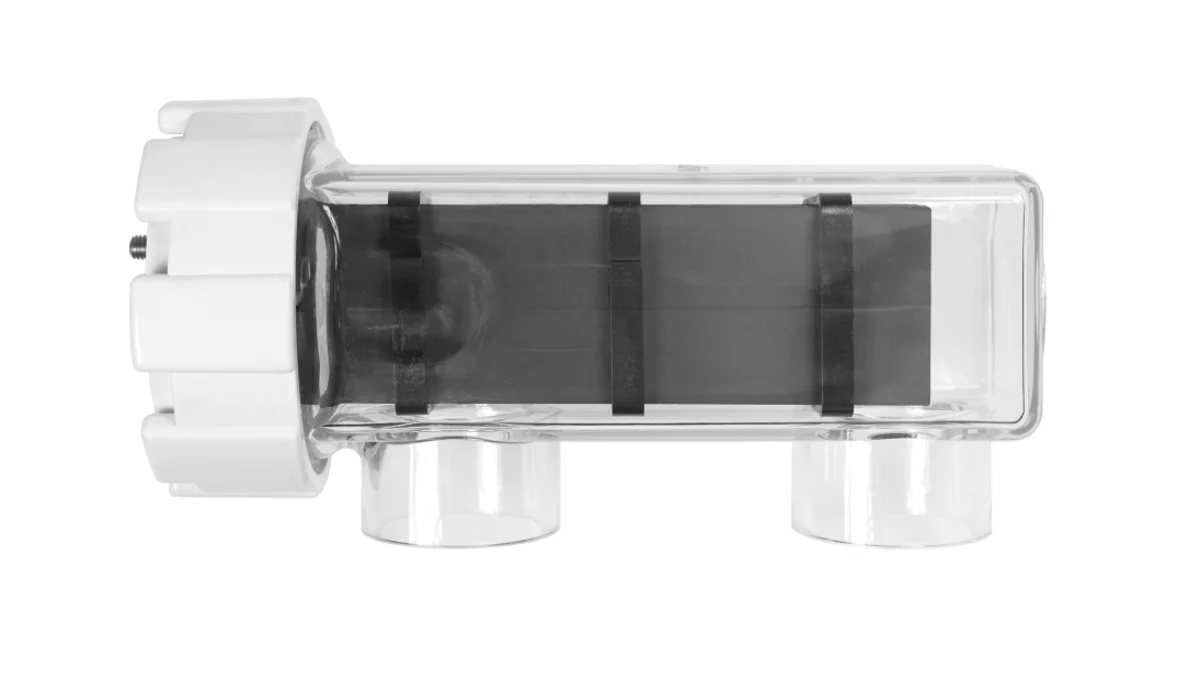
The main problem is limescale build-up on the titanium plates. Although many systems are "Self-Cleaning" (they reverse the polarity of the current to shed the limescale), in areas with very hard water this may not be enough.
- Visual inspection: Once a month, look through the transparent housing of the cell.
- Cleaning: If you see white deposits between the plates, remove the cell and immerse it in a mildly acidic solution (vinegar or a special cell cleaning solution) until the fizzing stops. Do not scrape the plates with metal objects, as you will destroy the precious metal coating.
Common mistakes
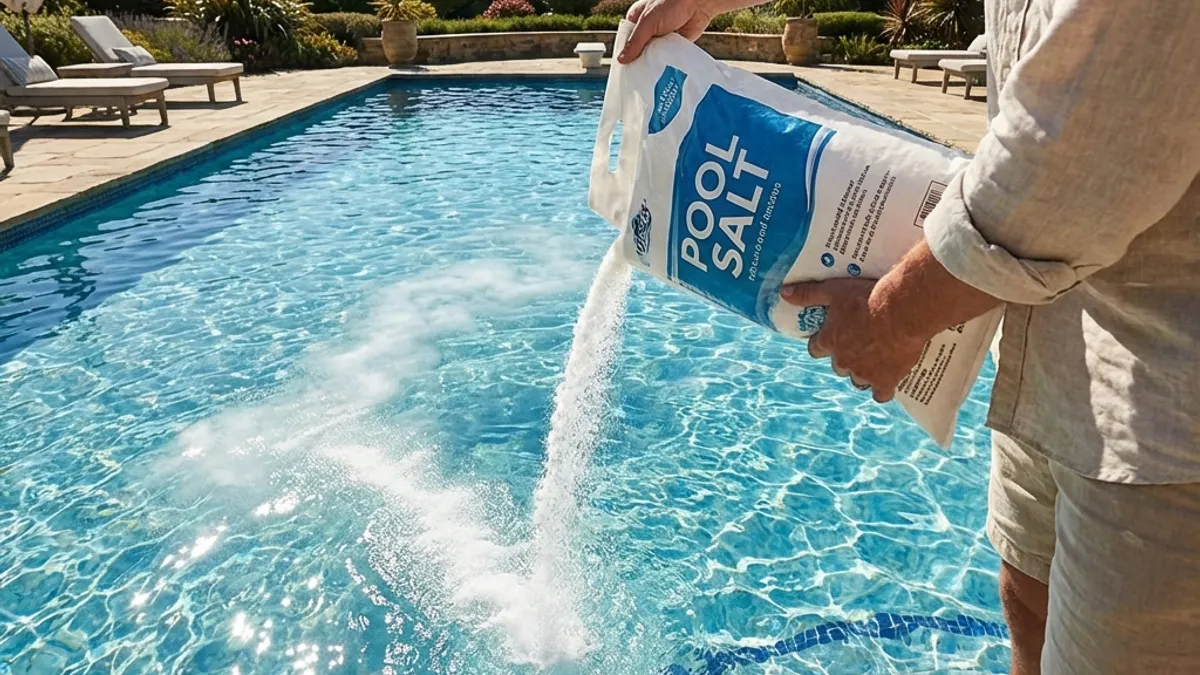
- Adding salt directly into the skimmer: The massive salt concentration goes straight into the pump and filter, risking corrosion. Salt should only be scattered directly into the pool, over the whole surface, and brushed until it dissolves.
- Ignoring pH: High pH is one of the most common problems in salt pools.
Frequently asked questions
Does the water in a salt pool feel different from a conventional one?
Does a salt water pool stain swimsuits or skin?
Is it normal not to smell chlorine, even though the water is treated?
Can white deposits appear on the edges of a salt pool?
Should the electrolyser be switched off when topping up the pool water?
Can I start the electrolyser immediately after adding salt?
1. Switch off the electrolyser.
2. Pour the salt into the pool.
3. Leave the pump circulating for 24 hours.
4. Start the electrolyser only when you can no longer see any salt crystals on the pool floor.
Is it normal to add more salt during the season?
What signs show that the electrolyser is no longer producing enough chlorine?
2. The device displays a "Low Salt" or "Check Cell" error.
3. The water starts to turn milky or green algae spots appear, even though the pump runs non-stop.
Who electrolysis is suitable for
When it can be a suitable option
- For families with children (sensitive skin, eyes open underwater).
- For owners who want to stop handling and storing containers of liquid chlorine or buckets of tablets.
- For those who have a holiday home and cannot be there every week to dose tablets.
When it may not be the best choice
- If you have low-quality stainless steel parts (not 316L stainless steel) or unprotected metal ladders – the salt will rust them quickly.
- If the initial budget is very tight.
What to understand before choosing
Electrolysis does not work without any intervention. It spares you the daily effort of manual dosing, but it requires regular checks of the water balance (pH, salinity) and periodic cleaning of the cell.

Eng. Răzvan Pavel
Technical Activity Coordinator at Karma Pro Pools as Technical Manager. Graduate of University Politehnica of Bucharest in 2000. Exclusively active in the swimming pool industry since 2007, coordinating over 500 residential and public projects.
Want a pool like the ones in magazines?
Book a free consultation with our experts and let's turn your dream into reality.